
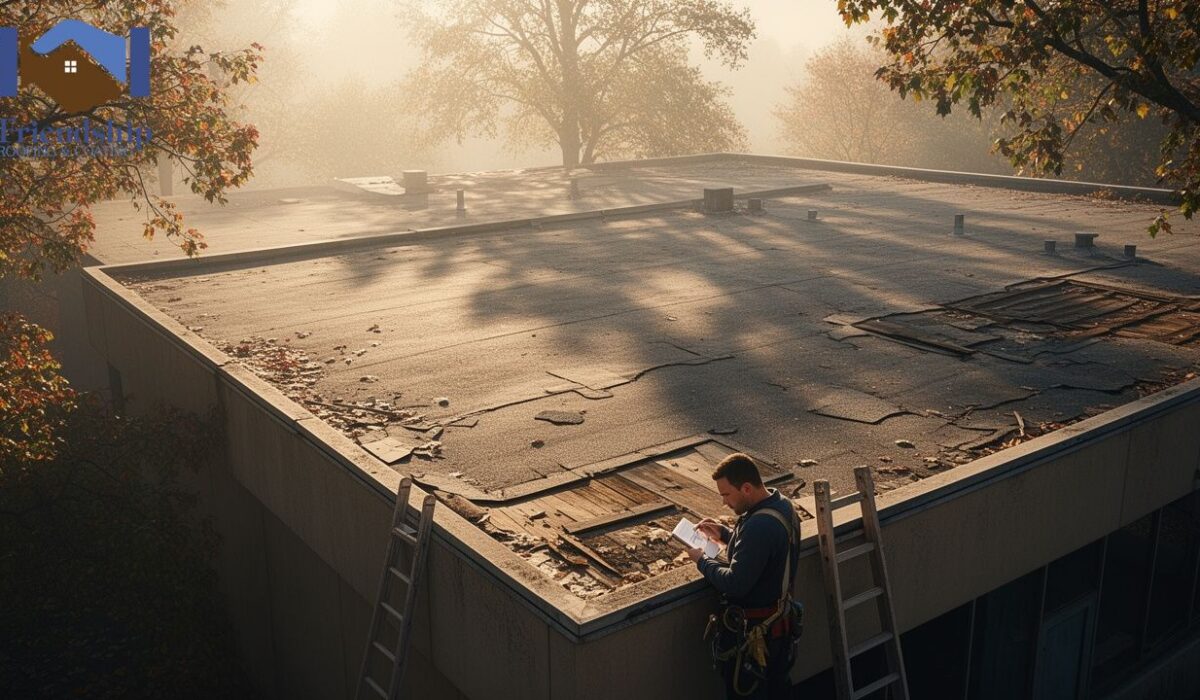
A flat, low slope commercial roof rarely fails as a roof in an obvious way. No shingle is concealed from the parking lot. Commercial roofing failures build slowly, and most of them are visible well before repair costs turn into replacement costs.
After 48 hours or more of sitting water on a roof after a rain, the Asphalt Roofing Manufacturers Association reports that measurable water weights can begin to contribute to the deck not designed to support it.
Friendship Roofing & Coating provides inspection, repair, and restoration services for commercial roofing systems, and this article discusses what should really be addressed: the early signs of roof damage, the actual components of a roof inspection, and the patch/repair/tear-off decision.
Warning Signs of Roof Damage
A stain or a bubble doesn’t automatically mean a roof is failing. But certain Warning Signs of Roof Damage on commercial roofing systems tend to precede full restoration by a year or two, and they’re worth learning to recognize.
Ceiling stains that spread between rain events, not just after them, point to water trapped in the insulation and moving laterally. Soft or spongy footing near drains and seams means the deck below has taken on moisture.
Roof Ponding Water: Causes and Risks
Roof ponding water is one of the most underrated problems in commercial roofing. Ponding is defined by the National Roofing Contractors Association as water staying on a roof more than 48 hours after rain when it should dry. The water pit seen two days after it rained, each time it rains, is a sign of drainage or deck issues.
Water is approximately 8.3 pounds per gallon. A small pond on a small portion of the roof can add several thousand pounds of dead load and continue to depress the deck over time, further concentrating water for the next rain, and so on.
Documenting a ponding location with photos and measurements taken 48 hours after rainfall gives an inspector something concrete to work from when deciding whether commercial roof restoration or a targeted drainage fix is the right call.
Roof Membrane Damage
Roof membrane damage presents differently by system. EPDM tends to shrink at the perimeter, pulling seams apart. TPO fails at the heat-welded seams and develops a chalky white residue on the surface. Built-up and modified bitumen roofs show granule loss and exposed felt as the surface wears.
Damage spread across multiple seams on the same commercial roofing membrane is a different situation, and it’s usually the point where patching individual spots stops being cost-effective compared to treating the whole surface.
Roof Blisters and Cracks
Roof blisters and cracks are most frequently found on modified bitumen and built-up roofs. Trapped moisture or gas expands under the membrane with heat and forms a bubble, which will eventually burst.
Dozens of them are grouped around seams and penetrations: adhesion has been lost over a broad area. Coating or overlaying the surface at that stage generally makes more sense than treating each blister as its own repair.
Commercial Roof Restoration
The restoration process often begins by cleaning up and repairing seams, blisters, and flashing detail on the existing roof membrane, followed by a fluid-applied coating (silicone, acrylic, or polyurethane depending on the roof surface) over the entire roof surface. A commercial roof coating cost guide can also help property owners understand the pricing factors involved when coating is part of a restoration project.
Some coatings need a primer coat before they’ll bond to certain membrane chemistries, EPDM in particular, and a commercial roofing contractor should be able to explain which repairs happen before coating and why a specific product was chosen for that roof rather than a generic one.
Commercial Roof Leaks That Cause Problems
Most often, water from a commercial roofing membrane leak will not be visible immediately under the leak. It will cross the deck or the structure before finding a way to go down through the insulation, which is why a ceiling stain may be forty feet from the actual point of entry. Patching on the inside of the building is not on the source; it is on the exit point.
Commercial roof leaks with that pattern are a reasonable trigger for a broader inspection instead of another round of interior patching.
Signs of Roof Deterioration
The most common places for signs of roof deterioration to appear are rooftop units, vent stacks, skylights, and pipe penetrations. All penetrations are seams, and all seams are potential entry points. Even a quarter of an inch of flashing off of the curb is enough to begin a leak. Sealant that’s shrunk and separated from the substrate is common on roofs past the ten-year mark, particularly where temperatures swing hard between seasons.
A roof can have a field membrane in reasonably good condition and still get flagged during inspection almost entirely for deteriorated flashing detail around a handful of curbs. Detail work around penetrations often needs attention well before the flat field of the commercial roofing membrane does.
Roof Moisture Damage You Can’t See
Roof moisture damage can leave a roof looking sound from the surface while problems develop underneath. Saturated insulation becomes much less effective and also heavier to add to the assembly, and doesn’t dry out by itself after absorbing water.
Skipping that scan before restoration creates two possible outcomes: replacing insulation that didn’t need it, or coating over insulation that’s still wet and will keep degrading underneath the new surface. Either one wastes part of the commercial roofing budget.
Commercial Roof Inspection
A commercial roof inspection is a visual inspection of the membrane, seams, and flashing; a drain and scupper inspection for blockage; a slope inspection for any ponding locations, and in older roofs, a moisture inspection.
Ask for the inspection in writing, and for photos to be attached to areas of the roof instead of a verbal summary. A lot of commercial roofing companies would want to have documentation of the inspections to maintain the warranty, and if a storm or wind damage claim arises, that document comes in handy.
When to Restore a Commercial Roof
Deciding when to restore a commercial roof is dependent on several overlapping conditions: the membrane has yet to structurally fail, but it is badly worn; moisture intrusion is confined and not throughout the entire roof; and it’s been beyond the original roof membrane warranty.
It may be even better to consider a fifteen year-old commercial roofing system that has been well maintained as a restoration project than an eight year-old that has been neglected.
Roofs that go years without attention often reach the same age already needing full replacement, because deferred maintenance did more damage than the roof’s age by itself.
Roof Restoration vs Replacement
Roof restoration vs replacement comes down to what the deck and insulation can actually support, not preference. Restoration works when the substrate underneath the existing membrane is still sound. It skips the tear-off, which cuts disposal costs and keeps old roofing material out of the landfill, and it’s the more common outcome for a commercial roofing system that’s been maintained along the way.
| Factor | Restoration | Replacement |
|---|---|---|
| Existing deck condition required | Sound, minor wear | Assessed regardless |
| Tear off required | Usually no | Yes |
| Disruption to operations | Low to moderate | Higher, longer timeline |
| Best fit | Isolated damage, sound substrate | Widespread failure or deck damage |
Commercial Roof Repair vs Restoration
Commercial roof repair covers isolated problems, a blister here, a flashing detail there. Once those individual issues become common enough that patching them on one by one becomes too reasonable to keep up with, restoration becomes the more sensible choice.
A commercial roofing contractor who’s inspected the roof directly is better positioned to say which side of that line a specific roof falls on than any general rule.
Commercial Building Roofing Systems
There are several different types of roofing common in commercial building roofing(TPO, EPDM, modified bitumen, built-up, metal), as well as various types of restoration methods. Coatings and heat-welded seam repairs are not too difficult to accept for TPO and PVC.
Built-up and modified bitumen roofs can accept a broader range of coating products, though surface preparation matters more given the granulated surface.
Reflective coatings add a secondary benefit worth factoring in. EPA research on heat islands found that a white roof reflecting a high percentage of sunlight can run roughly 50 degrees cooler on a summer afternoon than a dark, unreflective roof. For commercial roofing in warmer climates, that translates into a real reduction in cooling load, separate from whatever prompted the restoration in the first place.
Extend Commercial Roof Life
A roof under a documented, twice-yearly inspection schedule tends to outlast an identical roof that only gets attention when something leaks. To extend commercial roof life, that means keeping drains clear of debris, addressing membrane damage while it’s still isolated, and resealing penetrations on a schedule rather than after a leak forces the issue.
Prevent Costly Roof Repairs
Install and maintain a roof drainage system; after major storms, walk the roof to make sure there are no problems; keep drains clear; and have the roof inspected by a professional at least once a year, or more often, in hail-prone or freeze-thaw climates to Prevent Costly Roof Repairs.
None of that requires much budget. A commercial roofing deck replacement caused by three years of ignored ponding water does.
Choosing a Commercial Roofing Contractor
The commercial roofing contractor should be able to give you a written scope of work, pictures of the existing roof, a good understanding of what is causing a change order, and manufacturer’s specifications of any coating or membrane roofing system he is proposing. Ask why before signing any agreement if a contractor says they can do the restoration without first checking the condition of the deck and insulation, or refuses to wait until they determine if the deck/insulation needs replacement first.
Deciding between repair, restoration, and replacement starts with an accurate picture of what’s happening under the surface, not with the price on a proposal. Friendship Roofing & Coating can walk a specific roof and lay out what it actually needs. Reach the team at (319) 321-0694 or am@friendshiproof.com.
Frequently Asked Questions
How long does a roof restoration project typically take?
It depends heavily on roof size and how much repair work has to happen before coating can start. A small roof with minor prep work might wrap up in a few days. A larger roof needing extensive seam and flashing repair can run two to three weeks, longer if weather delays the schedule.
Will restoration work disrupt normal business operations?
The work happens on the roof surface, so tenants and staff generally continue operating inside the building without interruption. A full tear-off replacement is a different situation, since it involves more noise, more equipment on site, and a longer timeline overall.
Will there be any coverage available for restoration costs?
Coverage is dependent on the cause. Damage that is caused by a specific storm, hail, or wind event is more likely to be covered than damage due to the passage of time. Consider the policy text literally and ensure that you have an inspection report to hand before raising anything.
When should a commercial roof be professionally inspected?
Most buildings are covered twice a year, usually in the spring and fall. Include an inspection after a large storm, even if one is not scheduled – and structures that are in harsher climates or those with older roofs may require more frequent inspections.
Sources
- National Roofing Contractors Association (NRCA) industry guidance defining the 48-hour ponding threshold used across manufacturer warranties and building codes for low-slope membrane roofs.
- Asphalt Roofing Manufacturers Association (ARMA), “Ponding Water Basics: Proper Drainage Design and Low-Slope Roofs,” on structural risks of ponding water on low-slope roof decks.
- U.S. Environmental Protection Agency, “Using Cool Roofs to Reduce Heat Islands,” on solar reflectance and surface temperature reduction for reflective roofing systems.
- U.S. Department of Energy, Federal Energy Management Program, “Purchasing Energy-Efficient Cool Roof Products,” on reflectance and emittance specifications for commercial roofing materials.