
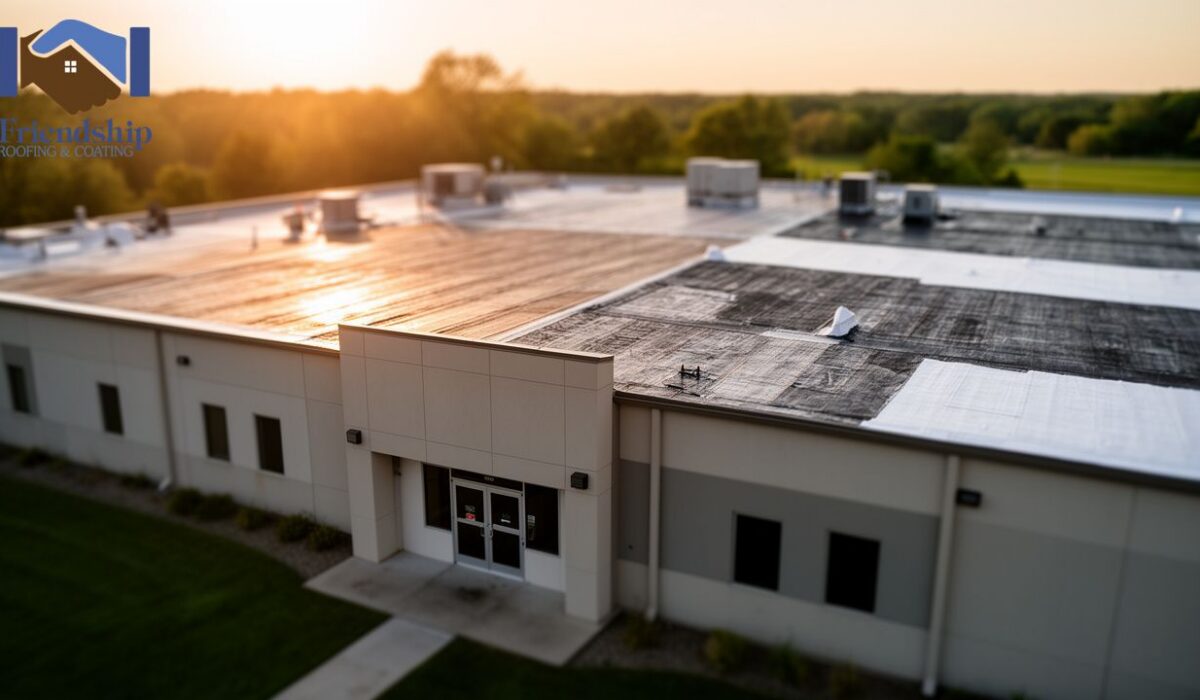
The cost of a commercial roofing coating project in eastern Iowa ranges from $0.75 to $6.00 per square foot installed, depending more on the type of coating that will be applied than on the size of the building. A 20,000 square foot warehouse with a sound deck and minor wear will fall close to the low end of the spectrum. Standing water on the roof after each storm along with flashing being pulled away from the parapet wall can make the estimate run a lot further before each gallon is used.
Why Commercial Roofing Costs Vary So Much on Eastern Iowa Flat Roofs
The single biggest factor isn’t the coating brand or even the square footage. It’s roof condition at the time of inspection. According to industry cost-estimate resources like ENERGY STAR’scommercial roof products program, reflective coatings can reduce roof surface temperatures significantly during peak summer months, but that performance benefit only materializes if the substrate underneath is structurally sound. Coating over a compromised deck is a warranty problem waiting to happen, and most manufacturers won’t back a coating system applied over unresolved wet insulation.
TPO and EPDM membranes are prepared differently from built-up asphalt roofs and the National Roofing Contractors Association has provided guidance which indicates that the chemistry of the roof substrate can affect the requirements for primer and time for cure. The wrong primer between two or three years and the fifteen year time period is one of the more common causes of premature failure of a modified bituminous roof from the 1990’s, as opposed to a 5 year old TPO membrane.
Commercial roof restoration through coating only makes financial sense when the roof still has structural life left. Property owners should also consider commercial roof restoration vs replacement based on the roof’s condition, remaining service life, and overall repair costs. A roof with widespread membrane cracking, multiple layers of prior patch repairs, or insulation that’s saturated below the surface usually costs more to prep for coating than it would to replace outright. Contractors who are honest about this tell clients no more often than contractors chasing volume.
For buildings where the deck is still solid, commercial roof coating Iowa property owners choose usually extends roof life by 10 to 15 years at a fraction of tear-off and replacement cost. That math works because coating doesn’t require removing the existing membrane, disposal fees, or the labor of a full re-roof. It only works, though, if someone actually inspects the roof core, not just the surface, before quoting the job.
Commercial Roof Coating Cost Per Square Foot: What Eastern Iowa Buildings Actually Pay
Once a contractor confirms the deck is sound, the next question is which line items actually make up the bid. Roof prep, primer, and the topcoat itself are separate cost categories, and buildings of different sizes hit different pricing tiers because labor and material waste don’t scale in a straight line.
| Cost Category | Small Roof (5,000 sq ft) | Mid-Size Roof (15,000 sq ft) | Large Roof (30,000+ sq ft) |
|---|---|---|---|
| Surface prep & pressure washing | $0.20–$0.35/sq ft | $0.15–$0.28/sq ft | $0.12–$0.22/sq ft |
| Repairs (seams, fasteners, flashing) | $0.30–$1.20/sq ft | $0.25–$0.90/sq ft | $0.20–$0.75/sq ft |
| Primer application | $0.15–$0.30/sq ft | $0.12–$0.25/sq ft | $0.10–$0.20/sq ft |
| Coating topcoat (material + labor) | $1.10–$3.50/sq ft | $0.95–$3.00/sq ft | $0.80–$2.60/sq ft |
| Warranty & inspection | $0.10–$0.25/sq ft | $0.08–$0.20/sq ft | $0.05–$0.15/sq ft |
Factors That Affect Roof Coating Cost Beyond Square Footage
Roof access changes the number more than most property owners expect. A single-story retail building with a ground ladder and clear staging area costs less to work on than a four-story mixed-use building where crews need boom lifts or roof-mounted anchor points for fall protection. Iowa’s OSHA fall protection standards for low-slope commercial roofing require guardrails, safety nets, or personal fall arrest systems above a certain height, and equipment rental for that adds a line item that has nothing to do with the coating itself.
Types of Commercial Roof Coatings & Their Costs
Not every coating chemistry performs the same way on an Iowa roof that swings from subzero January mornings to 95-degree July afternoons with high humidity off the Mississippi and Cedar River valleys.
Silicone Roof Coating
Silicone roof coating is used on roofs that have ponding water and UV exposure problems due to its much better ability to do so compared to most alternatives, and is often used on roofs where the issues with ponding water and/or UV exposure cannot be completely resolved before the project schedule. Does not yellow and breaks down slowly in extended wet conditions. The compromise is a higher price for the material and the surface will gather more dirt than acrylic because silicone water self-cleaning isn’t the same as some acrylic formulations when it rains.
Acrylic Roof Coating
Acrylic roof coating is relatively inexpensive per gallon and is easy to apply in moderate temperatures, which is why it is often used in buildings that have good drainage and no history of ponding. Lacks is less durable in regions with long periods of standing water, and is more temperature sensitive for application. In eastern Iowa, normal crews require a dry forecast window with temperatures above 50 to have a complete cure; this reduces the window for when a dry day can be used to when temperatures are above 50, which is roughly April through October.
Elastomeric Roof Coating
Elastomeric roof coating is a general term that is used to describe both acrylic and silicone based coatings that are designed to stretch and contract with the roof membrane over the freeze-thaw cycles in Iowa without cracking. This is significant for buildings with noticeable Jan-Jul shrinkage or expansion. The inexpensive roof coating that changes with the seasons will usually develop seam fractures in about two years.
What Iowa Weather and Code Requirements Add to the Roof Coating Price
Iowa’s coating season is shorter than it is in warmer states, and that compresses contractor scheduling in a way that affects roof coating price. Most manufacturers have a cool roof minimum surface and air temperatures, and November is a time when a roof may have to wait until spring to get coated or be scheduled for a rush job between rainy days. Contractors with a backlog of spring and fall projects may in some cases charge a premium price for late-season work due to the need to keep up with weather forecasts and to move people more rapidly when a dry spell is forecasted.
Local permitting can add time even when it doesn’t add much to the direct cost. Cedar Rapids and Iowa City both require permits for roof work above certain dollar thresholds, and buildings in floodplain zones near the Cedar River sometimes have additional inspection requirements tied to insurance compliance. Permitting delays, more than material delays, are usually what pushes a project from a two-week estimate to a six-week one.
Safety, Warranty, and Manufacturer Compliance Standards
A coating system is only as reliable as its documented compliance with manufacturer specifications. Most reputable coating manufacturers require moisture scans, either infrared or nuclear density testing, before they’ll issue a material warranty, because coating over wet insulation guarantees premature failure regardless of how well the topcoat itself is applied. A contractor who skips this step to save time on the estimate is setting the building up for a warranty denial later.
Fall protection compliance matters just as much on a coating job as it does on a tear-off, since crews spend just as much time on the roof surface. A contractor who can’t produce proof of OSHA-compliant fall protection equipment and training records for their crew shouldn’t be handling a multi-day roof coating project, regardless of how competitive the bid looks.
The Coating Process | Step by Step
- Roof inspection and moisture scan: A contractor walks the entire roof surface and uses infrared or nuclear moisture detection to identify wet insulation before quoting the final scope.
- Primer application: A compatible primer is applied to the substrate, matched to whether the roof is TPO, EPDM, modified bitumen, or built-up asphalt.
- Base coat application: The first coating layer goes on at the manufacturer’s specified thickness, usually measured in wet mils to hit the correct dry film thickness.
- Top coat application: A second coat is applied once the base coat cures, building the total system thickness the warranty requires.
- Final inspection and warranty documentation: The contractor verifies coating thickness with a wet mil gauge at multiple points and documents the completed system for the manufacturer’s warranty registration.
Things to Consider Before Hiring a Commercial Roofing Contractor
Moisture testing methods
Ask whether the contractor uses infrared thermography, nuclear density meters, or core cuts to verify roof dryness, and whether that testing is included in the estimate or billed separately.
Manufacturer certification
Coating manufacturers often certify installers for warranty purposes. A commercial roofing contractor without current certification for the specific coating being proposed may not be able to offer a manufacturer-backed warranty at all, only a workmanship guarantee from their own company.
Mil thickness documentation
A contractor should be able to explain, in writing, the wet and dry mil thickness the project targets and how that will be verified during application, not just after the fact.
Local project history
A contractor who has worked on flat commercial roofing in the same climate zone understands how freeze-thaw cycling and seasonal humidity affect cure times, which matters more than general roofing experience from a different region.
Warranty terms in writing
Ask specifically whether the warranty covers material only, labor only, or both, and what voids it. Ponding water exclusions are common and worth understanding before signing.
Answers to Common Questions
How long does a commercial roof coating last?
Most silicone and elastomeric systems are warrantied for 10 to 20 years depending on the manufacturer and mil thickness applied. Acrylic systems on roofs without ponding issues often reach the 10-year mark as well, though recoating at that interval is typically expected regardless of coating type.
What’s the best roof coating for commercial buildings in Iowa?
There is no single solution for all roofs. Silicone is a proven water-resistant material that performs well for buildings with drainage issues, whereas acrylic systems are water-resistant, and they work well for roofs with a good slope and without a history of ponding. It’s not a blanket recommendation; it depends on the particular drainage and movement of the roof in question.
Can coating be applied over an existing coating?
In most cases, yes, as long as the existing coating is compatible with the new product and still adhered properly. A contractor should test adhesion in a small area before committing to recoat over an older system.
Does commercial building roofing coating qualify for any energy incentives?
Reflective roof coatings can sometimes qualify for utility rebate programs or reduced cooling costs tracked through ENERGY STAR’s roofing guidance, though specific incentive availability changes year to year and should be confirmed directly with the utility provider before the project starts.
How disruptive is a coating project to normal business operations?
Coating is generally less disruptive than a tear-off because there’s no demolition noise or debris removal, though odor from certain coating chemistries can be noticeable for a day or two, which matters for buildings with rooftop HVAC intake near the work area.[a]
The best coating depends on the roofing system and building conditions. Silicone coatings are widely used in roofs that have ponding water, and acrylic coatings are suitable for roofs that have good drainage.
The best time to apply is normally from mid-spring until the early fall when the weather and temperatures are suitable for curing the coating.
The lifespan of a commercial roof coating in Iowa will vary based on the coating system, the quality of the installation, and the maintenance that is provided after installation. A commercial roof coating in Iowa may last 10 to 20 years before recoating is recommended, depending on the coating system, installation quality, and maintenance that has been done following installation.
Permit requirements vary by city and county within Iowa. Some commercial roof coating projects may require permits, especially if repairs or structural work are involved, so it’s best to verify local building requirements before starting the project.
Expert Advice for Eastern Iowa Property Owners
The roofs that have the biggest advantage from being coated are those where the problem was detected early, and the deck is still relatively dry and has a good remaining life in the structure. When a roof is starting to show signs of damage, the decision is either to do extensive preparation work and then replace the roof or to replace the roof, which is the least cost effective option. Coating is supposed to be the least expensive option, and when a roof is showing signs of deterioration it is no longer the least expensive choice.
Expert Support for Your Commercial Roofing Project
Friendship Roofing & Coating handles moisture testing, repair scoping, and coating application for flat and low-slope commercial roofing throughout the Cedar Rapids and Iowa City area, working directly with property owners to determine whether a roof is a genuine coating candidate or needs a different approach. Contact Friendship Roofing & Coating at (319) 321-0694 or email am@friendshiproof.com to schedule an inspection and get a scope-specific estimate rather than a rough square footage guess. A roof that’s been properly evaluated is the only kind of roof that gets an honest number.
Sources
- U.S. EPA ENERGY STAR – Roof Products Program.
- National Roofing Contractors Association (NRCA) .
- Whole Building Design Guide, National Institute of Building Sciences – Roofing Resources.