
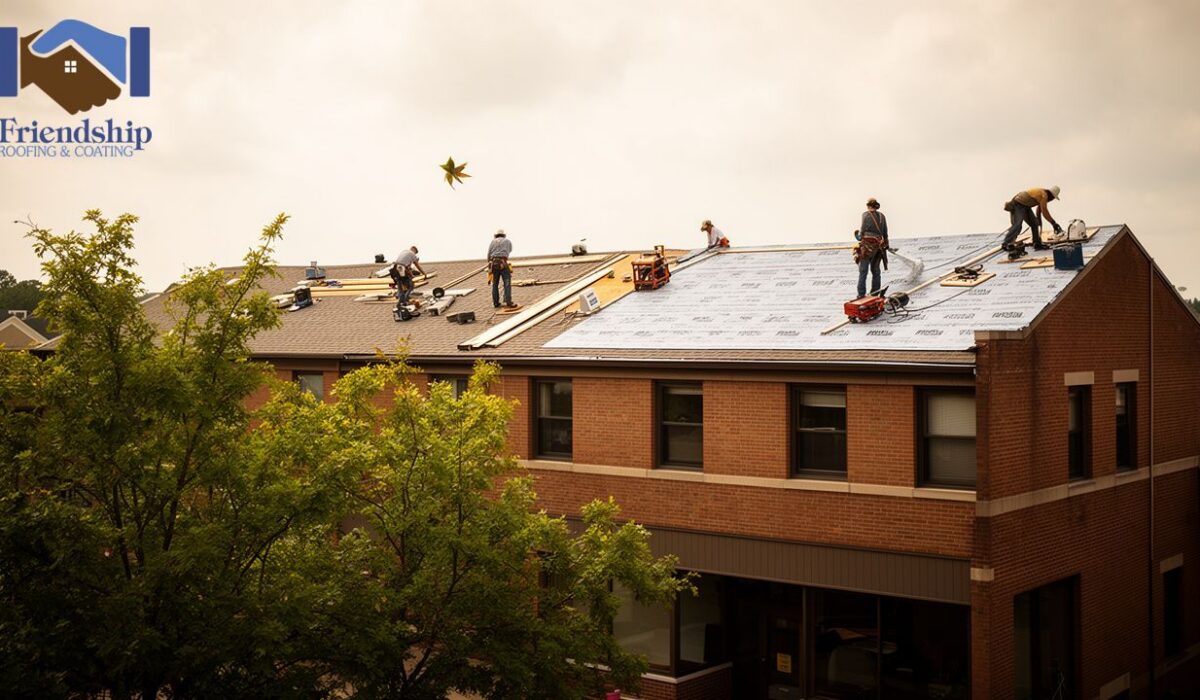
A hail dent or two on a metal roof doesn’t necessarily mean it’s time to tear off and start over. When deciding between an Iowa commercial roof restoration and a complete tear off, the decision in most cases is not what’s on the roof surface, but what’s underneath.
The key to the roofing restoration question isn’t whether it lowers cooling costs or extends service life by years, according to the U.S. Environmental Protection Agency’s ENERGY STAR roof products program, but that’s exactly why it is worth considering before signing up for a commercial roofing contract. The closer look begins at Friendship Roofing & Coating with a core sample and moisture scan, and not a sales pitch.
According to the U.S. Environmental Protection Agency’s ENERGY STAR Cool Roofs guidance, reflective roof coatings can lower roof surface temperatures, helping reduce heat transfer into commercial buildings.
Two paths for an aging commercial roof
Every flat or low slope commercial roof eventually hits a decision point. Membranes become stiff and lose flexibility, seams start to spread, and ponding water begins to seep through fastener heads. From that point, an owner is practically left with two choices: to take the next step toward Commercial Roof Restoration: Coatings and Repairs and/or to remove the existing system and install a new one.
The decision will have an impact on cash flow, tax implications, tenant disruption, and the length of time the building remains dry. Owners who make this a game of chance, instead of an engineering choice, typically spend tens of thousands of dollars on buildings less than 20,000 sq.ft.
What commercial roof restoration actually involves
Commercial Roof Restoration is a process, NOT a product. A contractor applies a fluid applied coating system, typically silicone, acrylic, or polyurethane, to the entire roof surface, cleaning and repairing any punctures and seam failures in the original membrane, and reinforcing flashing details around HVAC units and parapet walls.
When properly applied, this will increase the lifespan of a TPO, EPDM, modified bitumen, or built up roof by 10 to 15 years, without the expense and hassle of demolition.
The most underrated advantage of any benefit is thermal performance. On a sunny July afternoon in Des Moines or Cedar Rapids, a white or reflective roof can reduce the surface temperature of a roof by 50-60°F.
That matters for rooftop HVAC units, which run more efficiently and last longer when they aren’t baking on a black membrane all summer. Business owners chasing roof restoration benefits almost always mean two things: avoiding a five figure replacement bill and lowering summer utility costs at the same time.
Put simply, Commercial Roof Restoration pays for a chunk of itself through the utility bill before the warranty even kicks in.
Not all roofs are suitable for Commercial Roof Restoration. A contractor working on the project will need to ensure that the substrate is structurally sound and that there is no wet insulation underneath the membrane.
A layer of coating on top of the saturated insulation will not stop the moisture from getting in, but will only force it to rot the deck faster. This is where IR moisture scanning pays its price. It shows exactly where water has migrated, so the crew isn’t guessing.
Commercial roof replacement: when restoration no longer works
Commercial Roof Replacement becomes the only responsible option once the roof deck itself is compromised, or once wet insulation covers more than roughly 25 to 30 percent of the roof area. At that point, coatings can’t fix a structural problem, and Commercial Roof Restoration simply isn’t an option anymore.
A replacement typically means tearing off the existing system down to the deck, installing new insulation to meet current energy code, and applying a new membrane, often TPO or a modified bitumen system depending on the building’s use and roof slope.
Replacement also makes sense when a building’s insurance carrier flags the roof’s age during a policy renewal. Iowa insurers increasingly request roof condition reports on buildings older than 20 years, and a documented commercial roof replacement with a new warranty can lower premiums enough to offset part of the project cost within a few years.
Owners who attempt Commercial Roof Restoration on a deck that’s already failing usually end up paying for both the coating and the eventual tear off, since the coating never had a sound structure to protect in the first place.
Roof restoration vs roof replacement: the Iowa climate factor
Iowa’s weather does more damage to commercial roofs than most owners realize until they’re standing on one with a contractor. According to the National Weather Service’s Des Moines office, the state is located within hail alley, and severe convective storm activity can produce severe hail over the central Iowa hail alley, often during this spring and early summer.
This is the real heart of the roof restoration vs roof replacement debate for Iowa buildings. A membrane with isolated hail bruising or seam separation, but no structural deck damage, is often a strong restoration candidate. A membrane that’s been through five or six Iowa winters of freeze thaw cycling with no maintenance, and now shows deck deflection, usually needs full replacement.
The climate doesn’t decide the answer by itself, but it accelerates whichever problem already exists. This is exactly the kind of scenario where Commercial Roof Restoration either buys a building another decade of service or turns into wasted money, depending entirely on what the deck looks like underneath.
Roof replacement cost compared to restoration pricing
However, the cost of Commercial Roof Restoration may differ based on roof covering size, access, existing roof condition, etc., and the difference between the two approaches is typically significant enough to influence a capital budget decision.
| Factor | Restoration | Replacement |
|---|---|---|
| Typical cost per square foot (Iowa market) | $2 to $5 | $6 to $12 |
| Project duration for a 20,000 sq ft roof | 3 to 7 days | 2 to 4 weeks |
| Business disruption | Minimal, roof stays weathertight throughout | Moderate to significant |
| Added service life | 10 to 15 years | 20 to 30 years |
| Warranty typically offered | 10 to 20 years (coating manufacturer) | 20 to 30 years (membrane manufacturer) |
The Roof Replacement cost on a mid-size Iowa commercial building can be in the range of $120,000 to $240,000 depending on the upgrades needed to meet the current energy codes insulation requirements. If the deck is in good condition, a similar repair for the same roof can be expected to run anywhere from $40,000 to $100,000.
This is why so many building owners require a Commercial Roof Restoration quote before a replacement quote, and then look at the cost per year of the service life extension instead of the replacement costs.
When comparing quotes, it’s important for people to call each of the contractors involved to get the costs for cleaning, repair, and coating quoted separately, as this helps make it easier to determine if a restoration quote is competitive or not.
Flat roof restoration on Iowa commercial buildings
Flat and low slope roofs make up the majority of Iowa’s commercial building stock, from strip retail centers to warehouse and office park buildings. Flat Roof Restoration carries specific risks that pitched roofs don’t.
Ponding water is the biggest one. Any spot where water sits for more than 48 hours after a rain event is a candidate for accelerated membrane breakdown, and coatings alone won’t fix a drainage slope problem.
Sometimes the right fix is a tapered insulation system installed during a partial restoration, redirecting water toward existing drains before the coating goes on. Commercial Roof Restoration on a flat roof only works long term if that drainage problem gets solved first, not painted over.
Parapet walls and rooftop penetrations cause a disproportionate share of flat roof leaks. A crew restoring a flat roof in Iowa typically spends as much time on flashing detail work around vents, drains, and HVAC curbs as it does on the field of the roof itself, because that’s where 80 percent of leaks originate on a properly installed membrane.
Industrial roofing and commercial building roofing considerations
Industrial Roofing projects, think manufacturing plants, distribution centers, and cold storage facilities, add complications that a typical office building doesn’t face. Rooftop equipment loads are heavier, foot traffic for maintenance is more frequent, and chemical exposure from exhaust systems can degrade certain coating chemistries faster than others.
A silicone coating generally holds up better than acrylic under ponding water and UV exposure, which makes it a common choice for Iowa industrial sites with large flat expanses. Commercial Roof Restoration on these buildings needs to account for the extra equipment weight and traffic before a coating spec is finalized, not after.
The priority for Commercial Building Roofing choices for occupied office or retail is different: to minimize disruption to occupants. Restoration work is usually conducted in sections, allowing the building to remain mostly intact and operational during the restoration and minimal coordination of access and noise to tenants during working hours is normally needed when the building is having a full tear off.
Choosing a commercial roofing contractor in Iowa
The most important thing for roofing success is not the type of material used, it is the contractor. If the Commercial Roofing Contractor will not explicitly tell you why they are recommending a roof repair (or replacement) for your particular roof, then it’s possible that they haven’t taken the time to study the roof and insulation thoroughly enough to know.
Please request the moisture scan results, not just the statement “this looks fine. Any contractor bidding on Commercial Roof Restoration should be able to provide a portfolio of projects, not simply a generic portfolio, but a portfolio for the last three years that are similar to the job at hand in Iowa.
In Iowa, licensing and manufacturer specification are more important than in less harsh climates because an outside installation, even made by a qualified person, that is outside the temperature and humidity limits specified in the manufacturer’s designations may not last for 10 years or more, but rather may fail within a couple of years.
Iowa Commercial Roofing contractors installing year round should be aware of the difference in coating cure times between a 40 degree October morning versus a 90 degree July afternoon, and be ready to work accordingly.
Commercial roof restoration or replacement: a decision framework
Owners facing the Commercial Roof Restoration or Replacement question can generally work through it with four questions:
- Is the roof deck structurally sound, with no rot or deflection?
- Does wet insulation cover less than 25 percent of the total roof area?
- Is the existing membrane still attached and free of widespread seam failure?
- Does the building’s remaining useful life justify a 10 to 15 year extension rather than a 25 to 30 year system?
Three or four “yes” answers usually point toward restoration. Two or more “no” answers usually point toward replacement. A moisture scan and core sample answer these questions with data instead of guesswork, which is why any credible Commercial Roof Restoration bid should include one before quoting a price.
Get a roof assessment before you budget for either option
Friendship Roofing & Coating inspects the deck and insulation first, then recommends Commercial Roof Restoration or replacement based on what’s actually happening under the membrane, not on which service pays better. Call (319) 321-0694 or email am@friendshiproof.com to schedule an assessment before your next budget cycle locks in a number.
Frequently asked questions
When does a roof coating need to be reapplied?
Most silicone and acrylic coating systems have a 10 to 20-year warranty, but can vary based on ponding water, foot traffic and prepping the seams properly before application.
Can a leaking roof be restored, or does a leak always mean replacement?
It depends on the source. A leak from a failed seam or flashing detail is usually repairable and doesn’t disqualify the roof from restoration. A leak caused by a rotted deck or widespread membrane failure across the field of the roof usually points toward replacement instead.
Does a roof coating void the existing membrane manufacturer’s warranty?
Sometimes, and it depends on the original membrane manufacturer’s terms. Some manufacturers allow approved coating systems to extend the warranty period, while others require a separate coating manufacturer warranty once the original term has passed. A contractor should confirm this before recommending a coating.
When should a commercial roof be re-inspected after 15 years?
At least twice a year (usually spring and fall) and following significant hail and wind events. It’s almost always easier and more affordable to identify and fix a small tear in the seam or puncture early than it is to fix the water damage it can cause in the house.
What is the most common way hail damage is observed on commercial roofs in Iowa?
The damage from hail typically develops into small punctures or bruising on single ply membranes which may not be noticeable from ground level. On a metal panel roof, it manifests itself in the form of dimples. Regardless, there are two important points for roof insurance claims: one, the roof should be thoroughly examined by an insurance adjuster; and two, the roof should be examined by a roofing contractor as well.
Are older commercial buildings in cities like Davenport or Dubuque more prone to roof deck issues?
Buildings constructed before the 1980s in older Iowa river cities sometimes have wood deck systems that have absorbed decades of minor leaks before anyone noticed. A moisture scan is especially important on these buildings before committing to restoration.
Do Iowa cities require permits for commercial roof replacement?
Most Iowa municipalities, including Des Moines, Cedar Rapids, and Iowa City, require a building permit for full roof replacement, particularly when insulation or deck work is involved. Coating based restoration projects sometimes fall outside permitting requirements since the existing membrane isn’t removed, but local code offices should always confirm this before work begins.
Does Iowa’s freeze thaw cycle affect the timing of roofing projects?
Yes. Most coating manufacturers specify minimum application temperatures, generally above 40 to 50 degrees Fahrenheit with low humidity, which narrows the practical restoration window in Iowa to roughly April through October. Replacement projects have more flexibility since membrane installation methods vary by season and material.
Sources
- National Roofing Contractors Association (NRCA). Commercial roofing systems, maintenance, and technical resources.
- U.S. Environmental Protection Agency (EPA). Heat Island Effect and Cool Roofs.
- National Weather Service, Des Moines Forecast Office. Iowa severe weather and hail information.
- Whole Building Design Guide (WBDG), National Institute of Building Sciences. Roofing Systems and Building Envelope Design Guidance.